Learning Outcomes:
i. Define and differentiate between diploblastic and triploblastic organization in animals.
ii. Explain the developmental origins of diploblastic and triploblastic animals.
iii. Identify examples of diploblastic and triploblastic animal phyla.
iv. Discuss the evolutionary significance of triploblastic organization.
Introduction:
The animal kingdom exhibits a remarkable diversity of body plans and structural complexity. One of the fundamental distinctions among animals is their level of organization based on the arrangement and differentiation of their embryonic germ layers. Diploblastic animals possess two primary germ layers, while triploblastic animals have three.
i. Diploblastic Organization:
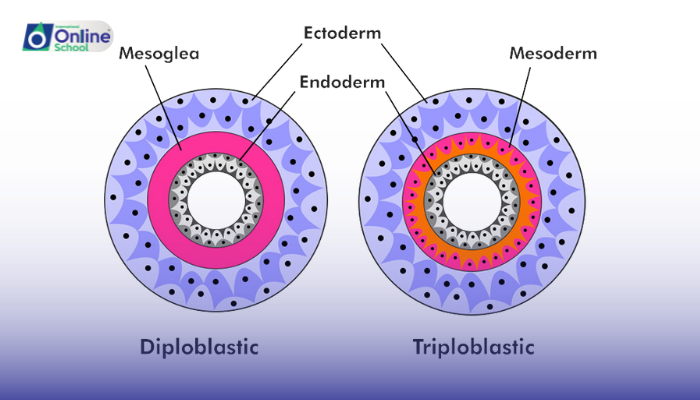
Diploblastic animals, such as cnidarians (jellyfish, anemones, corals) and ctenophores (comb jellies), are characterized by the presence of two primary germ layers:
Ectoderm: The outer germ layer, responsible for forming the skin and nervous system.
Endoderm: The inner germ layer, responsible for forming the lining of the digestive tract and other internal organs.
ii. Triploblastic Organization:
Triploblastic animals, including annelids (worms), mollusks (snails, clams), arthropods (insects, spiders), and vertebrates (fish, amphibians, reptiles, birds, mammals), possess three primary germ layers:
Ectoderm: The outer germ layer, responsible for forming the skin, hair, nails, and nervous system.
Mesoderm: The middle germ layer, responsible for forming muscles, bones, connective tissues, blood vessels, and the circulatory system.
Endoderm: The inner germ layer, responsible for forming the lining of the digestive tract, respiratory system, and other internal organs.
iii. Evolutionary Significance of Triploblastic Organization:
The development of three germ layers in triploblastic animals marked a significant evolutionary step, allowing for greater specialization and complexity of organs and systems. This differentiation enabled triploblastic animals to adapt to a wider range of environments and lifestyles compared to their diploblastic counterparts.
iv. Examples of Diploblastic and Triploblastic Animals:
Diploblastic Animals:
- Cnidaria (jellyfish, anemones, corals)
- Ctenophora (comb jellies)
- Platyhelminthes (flatworms)
Triploblastic Animals:
- Annelida (worms)
- Mollusca (snails, clams)
- Arthropoda (insects, spiders)
- Chordata (fish, amphibians, reptiles, birds, mammals)
The distinction between diploblastic and triploblastic organization in animals highlights the evolutionary progression and increasing complexity of animal life. The development of three germ layers in triploblastic animals paved the way for the diversification of organ systems, enabling them to thrive in diverse environments and exhibit a remarkable range of adaptations and behaviors.
